The Concussion Mistake Dads Keep Making
What to look for, when to worry, and why your kid is probably going to be just fine.

The Situation
Dads, I’m looking at you.
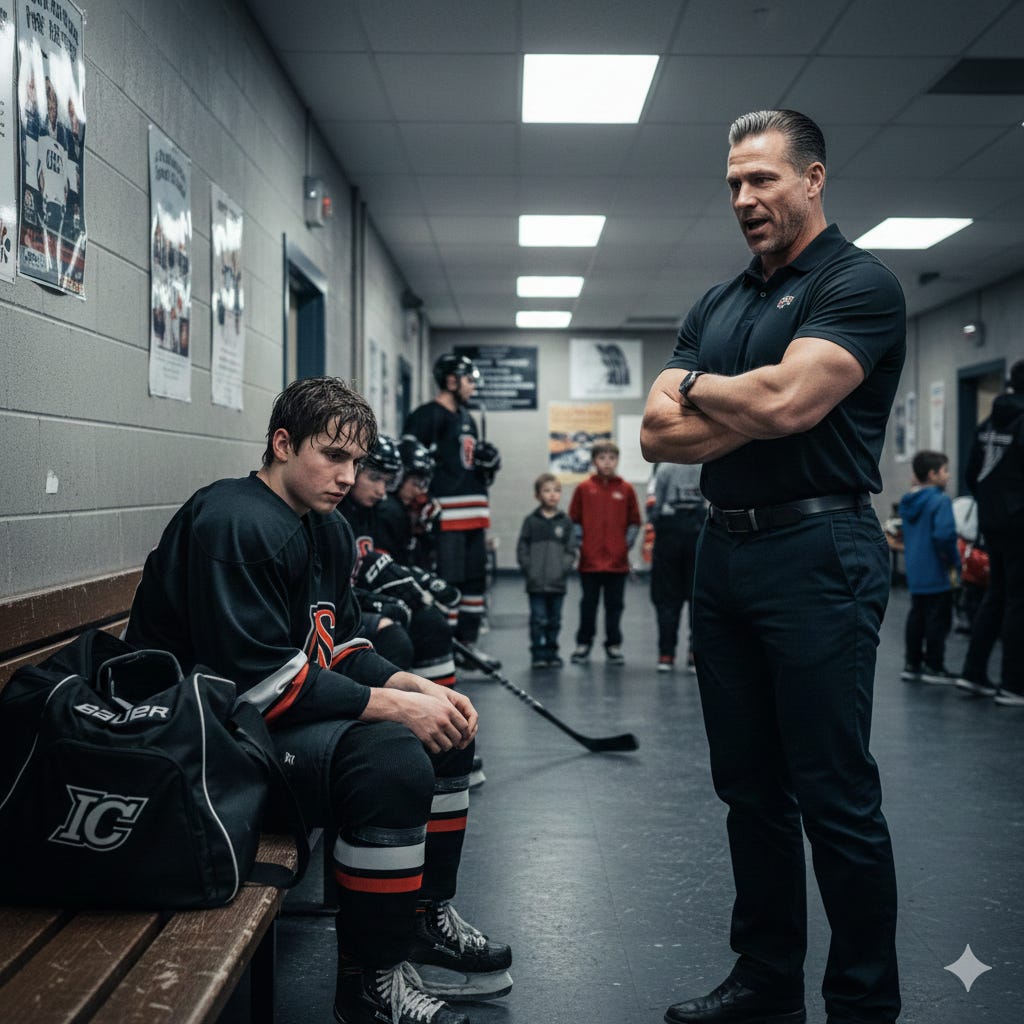
All throughout the year for the past six years, I have received a call from a lady (mom) regarding your shared kiddo who was involved in a legit hit or funky collision during their last game, and they’ve felt off since: your kid is nauseous, or the headache won’t go away, or they’re just fatigued beyond belief.
Mom has done some Googling (or ChatGPT-ing) and discovered this might be a — gasp — mild traumatic brain injury (mTBI; concussion)! She finds that I’m a local provider to your area and calls to schedule a consult. Awesome. Early care is a strong prognostic factor for faster recovery and safer outcomes.
Enter: Dad (sigh…).
You, Dad, always seem to “know a guy.” Let’s say your old college roommate is a cardiologist or emergency room physician, and they said, “Oh, concussion? Yeah, just have him rest it out. They resolve on their own.”
And so you cancel the appointment.
What I’m Actually Looking At
What I’m looking at is a dad (i.e., a man; the sex consistently shown to avoid appropriate medical care) dodging care for his kid because back in his day: (1) walk it off, or you’re soft, and (2) you didn’t pass out? Not a concussion. So, walk it off…
Meanwhile, for over a decade, the research has shown that strict and prolonged “resting and waiting” actually leads to worse symptoms and delayed recovery. With no intervention, there’s a ~30-40% chance your child has problematic symptoms for more than 30 days. And the worst part is that you and mom will usually then spiral into a “my child is 100% going to have CTE” rabbit hole — neglecting the fact that (1) your child has no conditions that meet legit CTE criteria, and (2) you were the one who neglected care in the first place. Remember, you “knew a guy?”
Usually, if mom actually took the time to call and we connected voice-to-voice… and you subsequently canceled the visit… I was seeing your kid 3-6 months later, trying to manage the post-concussion syndrome.
When a concussion is treated promptly, recovery takes only 21-30 days, on par with an ankle sprain.
Let’s Play With This
Hypothetical: Your kid sustains a grade II AC separation from a funky collision in lacrosse. This means a torn AC ligament, stretched coracoclavicular ligaments, and a slight visible bump. Recovery timeline is 2–6 weeks. Do you have them walk it off? Rest in a dark room until their shoulder magically regains strength?
Stupid hypothetical, right? You get your kiddo into physical therapy, a sling, and have them doing active rehab and mobilizations to avoid pain, future problems, and get them back to their sports, friends, and normal life. (Duh.)
Current hypothetical: Your kid sustains an mTBI (interchangeably called “concussion”) after a funky collision in lacrosse. The brain was functionally — not pathologically — stretched and sheared, triggering a neurometabolic cascade that results in a brain energy deficit, which resolves over 21-30 days.
Looking in the Mirror
Let’s literally mirror this for a second:
Shoulder? → Rehab!
Brain? → Hmmm… Pretend it didn’t happen, or hibernate until it magically resolves.
Do you see the problem? We’re living in a population that is overconfident in their knowledge of, and hyperscared of, Chronic Traumatic Encephalopathy (CTE) while also wildly neglecting appropriate care for the very thing (“the boogeyman”) that feeds that fear in the first place: head impacts.
And it’s not entirely your fault… the guy you knew was a physician. That physician gave you garbage, outdated, harmful advice.
So what do you do instead? Next time? This time?
The Game Is...
Concussion is not the problem.
Poor management of concussion is the problem.
Do it right the first time, and treat your child’s brain at least as well as you’d treat their shoulder. The recovery time is quicker when done right, anyway. Here’s your high-yield game plan:
Ingrain the mantra: “When in doubt, sit out.” Better to miss a period or quarter than a month or more. Immediate removal from play is the strongest predictor of fast recovery — athletes removed immediately return in 19–22 days. “Playing through it” for even 15 minutes increases recovery time to 28 days, while playing longer than 15 minutes doubles it to 44 days. Delayed removal correlates with more severe symptoms and a 47% higher likelihood of recovery exceeding three weeks.
Download the Concussion Tracker app. (It’s free, Dad, relax.) Full neurocognitive screening (the DANA) and balance testing, right in your pocket. Much better than guessing on symptom scores alone.
If there’s a suspected injury, use the Concussion Tracker App or Concussion Recognition Tool 6. These guide you through visible clues and reported symptoms — and more importantly, alert you to the red flags that mean you actually need the ER.
Got a diagnosis? Use the app to find a clinic near you. Every screening and balance test is logged and visible to these clinics once you become a patient. Evidence-based protocols, no extraneous fluff that doesn’t move the needle like you’d want (i.e., no HBOT tanks, no weird peptides).
Start now, while your kid is healthy. Baseline neurocognitive and balance testing gives you something to measure against. If there’s ever a funky hit… sit them out, screen with the app or CRT6, and get to prompt, timely care.
Share this with your dad buddies who “know a guy.”
Subscribe for content free of fluff and focused on keeping you (and your family) healthier... on purpose.
Healthy... On Purpose.
Selected references to send to the guy that you know who told your kid to rest:
Asken, B. M., Bauer, R. M., Guskiewicz, K. M., McCrea, M. A., Schmidt, J. D., Giza, C. C., ... & Svoboda, S. (2018). Immediate removal from activity after sport-related concussion is associated with shorter clinical recovery and less severe symptoms in collegiate student-athletes. The American journal of sports medicine, 46(6), 1465-1474.
Australian Institute of Sport. (2024, February). Australian concussion guidelines for youth and community sport. Australian Government; Australian Sports Commission. https://www.ais.gov.au/concussion1
Charek, D. B., Elbin, R. J., Sufrinko, A., Schatz, P., D’Amico, N. R., Collins, M. W., & Kontos, A. P. (2020). Preliminary evidence of a dose-response for continuing to play on recovery time after concussion. The Journal of head trauma rehabilitation, 35(2), 85-91.
Elbin, R. J., Sufrinko, A., Schatz, P., French, J., Henry, L., Burkhart, S., ... & Kontos, A. P. (2016). Removal from play after concussion and recovery time. Pediatrics, 138(3), e20160910.
Leddy, J. J., Haider, M. N., Noble, J. M., Rieger, B., Flanagan, S., McPherson, J. I., ... & Willer, B. (2021). Clinical assessment of concussion and persistent post-concussive symptoms for neurologists. Current neurology and neuroscience reports, 21(12), 70.
Leddy, J. J., Haider, M. N., Noble, J. M., Rieger, B., Flanagan, S., McPherson, J. I., ... & Willer, B. (2021). Management of concussion and persistent post-concussive symptoms for neurologists. Current Neurology and Neuroscience Reports, 21(12), 72.
Patricios, J. S., Schneider, K. J., Dvorak, J., Ahmed, O. H., Blauwet, C., Cantu, R. C., ... & Meeuwisse, W. (2023). Consensus statement on concussion in sport: the 6th International Conference on Concussion in Sport–Amsterdam, October 2022. British journal of sports medicine, 57(11), 695-711.
Wait, T. J., Eck, A. G., Loose, T., Drumm, A., Kolaczko, J. G., Stevanovic, O., & Boublik, M. (2023). Median time to return to sports after concussion is within 21 days in 80% of published studies. Arthroscopy: The Journal of Arthroscopic & Related Surgery, 39(3), 887-901.